Showing posts with label Book Review. Show all posts

Tuesday, January 3, 2012

Fairies Are So Hot Right Now

Now I've seen children and YA books with and about fairies for the last several years (and of course there's the centuries old popularity of fairy tales), but recently they really seem to have taken off.  All of my girls between the ages of 6 and 10 are into the Never Fairies and Rainbow Fairies series and some authors are trying to increase the range by writing and illustrating fairy books that are more gender neutral or geared towards boys.  So here's a post on fairy books, part Book List and part Review.

First for the younger kids there's the picture books by Bobbie Hinman. The most popular of these is the Fart Fairy. Which I'm not surprised appeals to kids, but personally I like to steer them away from bathroom humor.  There's also The Belly Button Fairy, The Knot Fairy, and The Sock Fairy.  Bobbie Hinman was an elementary school teacher, so she knows how to appeal to young kids.  All four stories are written in simple rhyme and have adorable and fun illustrations.  They're meant to appeal to boys and girls and children from a broad age range.  You can read them allowed to a 3 year old, with an emergent reader, or have a 7 or 8 year old read it to themselves.   If you buy them new they come with a read along CD, which can be great.

The Rainbow Fairies is a series about seven sister fairies who bring color to Fairyland, and the two human girls, Rachel and Kristy, who help the fairy sisters when they show up in our world.  These books fall into the easier reading range of chapter books.  The chapters are short, there are a fair amount of illustrations, and the stories not to long.  However, there aren't so many pictures that 3rd graders would scorn the books as "babyish".  I'd recommend this series for early Fluent readers (often 2nd and 3rd graders), it's the most popular series among my own students at the moment.  These books have been out for two or so years so the first part of the series should be available in libraries and used book stores.

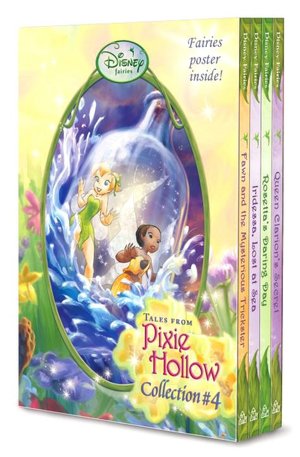
The Never Fairies of Pixie Hollow is a Disney franchise about Tinkerbell and her pixie friends.  There's movies and books and games and the general Disney characteristic of trying to get you to buy more, but the actual book series Tales from Pixie Hollow is pretty good.  They have good messages about friendship, working together, gaining new skills, the growing and changing of  a person, and other wonderful things.  The fairies all have different skills and professions, Tinkerbell's a blacksmith, and the illustrations portray them as different races (though they all have the same general body shape).  I'd recommend the series for fluent readers (it's a bit harder then the Rainbow Fairies series) so about the 3rd grade level.  However, I know a lot of older girls who also enjoy this series so they're good for older kids for an easier read or those who might have a lower reading level but don't want to look "babyish". Also, since the first books in the series came out a couple years ago they're easy to find at used books shops or in the library!

I've already reviewed Justine Larbalestier's How to Ditch Your Fairy which is Young Adult and a light read with an interesting world, great female friendships, queer characters, and a good message about working for what you want.  However, I was a little disappointed that the protagonist, Charlie, didn't seem to learn that lesson as well as her friends did.

And of course there are the traditional fairy tales and their more modern retellings. I'm sure many people remember Ella Enchanted by Gail Carson Levine.  It was published in 1998 and has won a Trophy Newbery and had a movie remake starring Anne Hathaway.  Levine has also retold the story of Snow White in Fairest and written her own fairy tales in The Tale of Two Castles and The Two Princesses of Bamarre.  I've only read Ella Enchanted and Fairest, and I preferred Ella Enchanted, but all the books are YA in regards to reading level and appropriate story wise for younger children. 

Tuesday, July 5, 2011

Book Review - The Demon's Surrender by Sarah Rees Brennan

The Demon's Surrender is the last book of the Demon's Lexicon Trilogy (reviewed here).  The trilogy follows the adventures of Nick and Alan Ryves, siblings Jamie and Mae, and Sin (Cynthia Davies) as they struggle with and against magicians and demons.  Each book has a different narrator, the first is Nick, second is Mea, and Sin is the narrator in The Demon's Surrender.

The whole trilogy emotionally focuses on family, especially siblings as each main character has at least on parent who has died or they're emotionally distant from.  This continues with Sin who is the main caregiver for her two younger siblings and partway through the book has to chose between staying with her sister or her place in the Goblin Market, of which she is the main demon dancer and presumed heir.

The content and reading level is still Young Adult, but The Demon's Surrender is a little bit more sexual then the previous books.  A lot of this comes from Sin having to use her beauty to attract clients.  Some also comes from Sin being mixed race and therefore having to deal with more street harassment and objectification then Mea.  I really liked how Rees Brennan addressed this in the book.  It's, realistically, a daily part of Sin's life, but her race is by no means her defining characteristic. 

This book also most closely addressed Alan's limp with Sin being more bothered by it (because of her career as a demon dancer) then Nick or Mea is.  It also is better about showing Alan's own relationship with his disability since he and Sin have several conversations about it.   

There are also two scenes of graphic violence that could easily be disturbing to readers.  Both involve torture and one includes self mutilation.  I think Rees Brennan handled them well, but they were a bit more intense then other scenes with violence in The Demon's Surrender or other books in the trilogy.   There is a bit more violence in the book over all as it has the final battle between the main characters and magicians, and Sin, like Alan and Nick, has basically grown up fighting.

Anyway, I completely loved this series and think it's a great book to introduce boys and girls to fantasy.  Also Sarah Rees Brennan has written several short stories in the Demon's Lexicon universe.  You can find them here.

Sunday, May 8, 2011

Book Review - The Hunger Games by Suzanne Collins

The Hunger Games by Suzanne Collins is the first book in the Mockingjay Trilogy which follows the story of Katniss Everdeen as she attempts to survive in the post-apocalyptic world of Panem.  Panem is the remains of a war torn North America and is separated into twelve districts and the Capitol.  It experiences class and wealth divides with the Captiol having a extreme wealth and plenty of resources, while many of the districts surviving on little.  Approximately 100 years ago a war was fought over this set up.  This civil war resulted in District 13 being "obliterated" and the yearly gladitorial Hunger Games where two children of each district fight.  Katniss volunteers to take the place of her younger sister and immediately becomes a figure of interest in the year's Hunger Games.  Her attempts to survive and save the lives of other children in the games leads to political instability which becomes the major plot points of Catching Fire and Mockingjay.

I devoured the Mockingjay series in about a week.  The writing is good, most of the characters are well developed, and the themes, sometimes shown only by small details, are deep and relevent.  They are also rather adult.  This book is considered Young Adult, but I think part of that classification comes from the ages of the characters.  Katniss starts the series as the age of 16. 

However the book portays the brutal death of multiple children and teenagers.  It also deals with PTSD, alcohol and drug addiction and contains multiple cultural critiques such as classism, racism, and an entertainment obsessed culture.  It's incredibly deep. 

While I think teenagers can read and appreciate The Hunger Games and the rest of the trilogy I think they have to be emotionally mature to do so.  A twelve-year-old might understand the words and follow the story, but this series is more on the sixteen-year-old end of the YA classification. 

This is certainly a series that leads to discussion.  It's great for a book club or for parents and teens to read and discuss together.  This is also a way for younger teens to read the book and gain understanding of the more mature themes in the book.

As a YA book The Hunger Games is for Self Extending Readers and ones at the higher end of the level.  Readers definately need some background knowledge on Roman history and the geography of North America to understand the layout of Panem and the significance of gladitorial games.  To catch the classism and racism that is portrayed readers obviously need to have some understanding of these issues and how the manifest in small ways.  Even then some readers are likely to miss that the poorer discricts and people are more likely to have darker coloring as this is something that Collins portrays through character descriptions, but doesn't explain the significance of.

As a side note there is a movie of The Hunger Games and I imagine it will be very popular.  It will still be some time before the film comes out.  I'm always in favor of reading a book before seeing the film and I think it's good to see how the different mediums seek to tell the same story. The Hunger Games will be especially interesting in this regard as Suzanne Collins is helping to write the script.

Sunday, March 27, 2011

Book Review - How to Ditch Your Fairy by Justine Larbalestier

How to Ditch Your Fairy is set in the future city of New Avalon, Australia where many people have invisible fairies who give them certain skills, types of luck, or in some cases a great number of difficulties.  This is the story of Charlie, a sports lover, who is unlucky enough to have a parking fairy.  This means if Charlie's in a car it'll find the best parking spot no matter how busy the place.  She's always being called upon to help her mom, dad, and their friends or being kidnapped by fellow student Danders so he can do his shady business without worrying about finding a good parking spot for a quick get away.  

Charlie absolutely hates her fairy and spends most of the book trying to get rid of it so she can, hopefully, get a cool fairy, like her friend Rochelle's clothes shopping fairy.  Over the course of  the story Charlie makes a new friend in Fiorenze, deals with the ups and downs of first love, learns a bit about fairness, and spends as much time as she can becoming the best athlete possible.  

How to Ditch Your Fairy is written in first person, rather like it's Charlies diary.  I'm not the biggest fan of first person, but I got over my dislike of the tense by the end of the first chapter.   Charlie's a very focused character, her main concerns are sports and how her parking fairy is ruining her chances of being a great athlete.  This makes it very easy for the reader to enter into Charlie's mind and care about the same things she does.  However, it also means Charlie doesn't spend much time questioning the way things are and she can be throughtless and even a little cruel at times because Charlie doesn't spend much time trying to see things from other people's points of view.  This means she doesn't question her dislike of Fiorenze until she's forced to spend time with her and circumstances put Charlie in Fiorenze's shoes.  Likewise, she has a crush on Steffi, a new student, but doesn't try to get to know about him before he moved to New Avalon until he calls her on her self-centeredness.  However, by the end of the book Charlie's gotten a lot better at thinking about other people and what's important to them.

One thing I loved about this book is how Larbalestier shows the relationship between Charlie and Fiorenze.  Fiorenze is cursed with an All the Boys Like You Fairy and it makes Charlie and a bunch of other girls really resent Fiorenze and treat her horribly.  Over the course of the story Charlie realizes how unfair this all is and becomes good friends with Fiorenze.  I think this is very applicable to real life.  I see so many girls and women treat each other horribly because of men. So often you see stories, in songs, TV, movies, and books where the guy the female protagonist is into likes another girl and this means that other girl is a horrible person.  I hate these types of stories and what it teaches young girls, so I was so excited that How to Ditch Your Fairy shows the exact opposite.

One area I was disappointed in was Charlie's relationship with fairies.  The set up of the story seems like Charlie should be learning about how fairies can give people unfair advantages and that it's better to succeed on your own talents and hard work.  Other characters learn this lesson, they're worried about the consequences of what they're fairies get them.  However, even at the end of the book Charlie still wants a cool fairy and is really excited about the one she ultimately gets, even though it dimishes her personal hard work and success. 

So if you want to give your child or student a book about keeping an open mind, the importance of family and friendship, or how we should be considerate of other people and their wants and needs this is a great book.  If you want to teach a lesson about hard work and perseverance, be prepared to talk about Charlie's fairy obsession and her societies reliance on fairies to make things easier.

This book identifies as Young Adult and content wise it is better suited for 12 and older children.  At times it's necessary to think critically about Charlie's opinions and actions and most elementary school children will have a harder time considering this and making judgements.  Reading skills wise, this book can be used to help children work on learning the meaning of words through context.  It is set in an imaginary city in the future so the characters use slang that doesn't exist in the real world.  All of the words are included in a glossary in the back of the book, so even if kids can't guess an accurate meaning they don't have to spend much time looking for the answer.

The books Reading Level, and even the content of crushes, friendships, and getting on a sports team, can be managed by somewhat younger children.  Some of my forth graders are reading this book and enjoying it.  As long as people are Self Extending Readers they can manage the words and content of this book. (More on Reading Levels) I think How to Ditch Your Fairy is a book that sparks conversation so I definately would recommend it for a book club.

Saturday, March 12, 2011

Book Review - The Demon's Lexicon by Sarah Rees Brennan

The Demon's Lexicon is the first book of an urban fantasy trilogy that's set in England and follows brothers Nick and Alan Ryves, siblings Jamie and Mae, and Sin.

Magicians exist in the world of The Demon's Lexicon Trilogy, they blend in with regular humans and most people don't know of their existence.  Magicians have a small amount of power, but they crave more.  Magicians call up demons (beings of air from another world) and give them humans to possess in exchange for greater magical powers. 
Standing against the magicians is the Goblin Market, a loosely allied group of people who work to protect humans from magicians and demons, for a price.

Nick, Alan, and their mother Olivia are on the run from magicians, they have been for as long as Nick can remember.  Olivia used to be a member of the powerful Obsidian Circle, a group of magicians led by Black Arthur.  They drove her mad and she ran away, but Olivia stole something first, and since then all the magician circles have been hunting Nick and his family.  The Demon's Lexicon begins with a magician's attack on the Reeves family; during the clean-up Nick and Alan encounter Jamie and Mea, classmates of Nick, who've heard the Ryve's were the people to go to if you had a problem with demons.

We quickly learn that Jamie has been having nightly visits from a demon, and if you let them in they mark you.  One mark to form a doorway and the demons can follow you always, the second mark to allow demons to enter your dreams and means someone has to die, the third mark is the demon's eye and means you'll be possessed.  Jamie has been marked three times and his death seems certain, until Alan is marked by the same demon.

What follows is an adventure across England with visits to a Goblin Market and a dance to call up demons. Along the way family secrets are revealed.  Nick, Alan, Jamie, and Mea learn the importance of truth and lies, that magicians really can be anyone, and any human can house a demon under the right circumstances.

Nick is the narrator of the first book.  He's an incredibly focused character who only cares about himself and Alan, and the content of the book reflects this.  The story takes a very narrow view with other characters and information only being mentioned when they directly affect Nick and Alan.  This also means that the other characters are portrayed only through what Nick observes them do, he doesn't spend much time thinking about their emotions or motivations.

This changes in The Demon's Covenant where Mea's the narrator.  She's posssibly the most empathetic of the characters and focuses a lot of their emotions and motivations, though no one's all knowing.  Both books focus a great deal on secrets and last minute reveals so the narrators are seem carefully chosen as the people with some of the least information, or who are incapable or uninterested in finding out the secrets until they come to a head.

The Content and Reading Level of this trilogy is young adult.  It deals with romance, making out without much romance, sexual orientation and homophobia, racism, death of friends and family members, and several of the protagonists have to commit murder at different points (some deal with more PTSD like reactions to this than others).   While most 12 year olds can handle the reading level of this series not all of them will have the maturity to understand or appreciate the content.

While The Demon's Lexicon passes the Bechdel Test, even through the female conversations are of the blink and you'll miss them sort, The Demon's Covenant blows it away.  This book further developes the previous minor characters of demon dancer Sin, and Goblin Market leader Merris Cromwell.  It also introduces the reader to Mae's workaholic mother Annabel, and several important female magicians.  This isn't too surprising as Sarah Rees Brennan is an ardent feminist and has written numerous posts about female characters in her blog. (See herehere, and here , and yes here too) The last book in the trilogy casts Sin as the narrator so I imagine it too will have awesome representation of the ladies.

Rees Brennan manages a wonderful blend of heartbreak and humor.  Most of the main characters are sarcastic and call upon a gallows sense of humor to get them through dangerous situations.  Jamie is certainly the standout character though, his response to terror is the make hilarious comments that range from pithy to rambling.  In response to danger Nick grabs his sword, Alan makes plans, Sin does some combination of the two, Mea raises her chin bravely, and Jamie spends a couple minutes cowering and making quips before stepping up and doing what's necessary.  In my opinion this makes him the most relatable character.

The last book in the trilogy, The Demon's Surrender comes out this spring.  I can't wait for it's release.  This is one of the few books I have no problem paying hard cover prices for, even on my small child care provider's salary.

Saturday, February 19, 2011

Book Review - Silent Dreams by Dandi Daley Mackall

Dandi Daley Mackall is a children and young adult author who often writes about people who are or have been marginalized by society.  Silent Dreams is the story of Camilla, a young homeless girl, her mentally ill aunt, and how they relate to the community and find joy in the silent cinema of the early 1900s. The story introduces the reader to a variety of people who are homeless and was inspired by Dandi Daley Mackall's own introduction to a homeless woman.  The story of this encounter is included at the end of the book along with information about the history of silent film and a glossary for the words that children might not be familiar with.


Silent Dreams is also a poem.  The rhymes are standard couplets (the 1st and 2nd lines rhyme with each other).  It has an easy meter, almost a sing-song quality, that often makes poetry easier for children to read and understand.  Each page of the book is four lines which have one or two accompanying illustrations.   I think the illustrations are quite lovely (though in fairness I know the artist).   The vibrant colors are eye catching and the purple tones help add to the mood of the poem.

The content in Silent Dreams is appropriate for any age range.  It is set during a specific time in history and has to do with homelessness and mental illness so children might have questions and this is definitely a book I would read with kids and be prepared to discuss these themes with them.  The homelessness and mental illness are not the main focus of the story and are portrayed in a very open and accepting way.  This is a good book to use to introduce children to these issues, while showing them they don't need to be afraid of people who are homeless or have mental illness.  For children who have a personal connection to homelessness or mental illness it is especially important for them to encounter stories and characters with these issues to help children understand that they, or people they know, are not alone.  

The reading level for this story is about 1st grade.  The poetry adds a formula to the story and most words will be recognizable.  Words that aren't likely to be known to younger children are included in the glossary at the back of the book.  This is written at an Upper Emergent Reading level, but should be enjoyable to children who are not at that level.  As said before, this is definitely a book that I would read with children, even if they are Fluent Readers or above. 

Silent Dreams is the only book by Dandi Daley Mackall that I have read, but I'm definitely intending to read more.  Her books seem to have a variety of narrators and some deal with important times in history and/or help spread the stories of marginalized people.  I think it's important to support authors, especially children and young adult ones, who do this.  You can get more information about Dandi Daley Mackall and her books at her website Dandi Books  

Monday, February 7, 2011

Book Review - Love That Dog by Sharon Creech

Love That Dog is written as the poetry journal of elementary school student Jack.  It takes place over the course of a year as his class learns about poetry.  Every entry is a poem and most are free verse responses to poems or Jack's teacher Miss Strechberry. Other entries are Jack's poems inspired by ones they learned in class. Tying the majority of the entries together are poems about a dog, a blue car, and why Jack doesn't have a pet any more.

This book is a great introduction to poetry.  Some of the poems are short free verse responses, such as "I tried. Can't do it. Brain's empty."  Jack also writes poems in various styles, and excerpts from some of the poems mentioned in his class are included in the back of the book.

The content level of this book is appropriate for anyone in elementary school.  However, it does deal with the loss of a pet and some children might find this very upsetting.  The content also includes feelings of uncertainty and low confidence in regards to school work and deals with over coming these emotions.

 Creech's word choice is very simple, yet she portrays these rich emotions and experiences.  The reading level is about 2nd or 3rd grade. But with all the line breaks children should definitely be Fluent Readers if they're reading this book to themselves.  This book helps to develop the reading skills necessary for poetry.  Also we only read Jack's responses, but he references lessons and conversations with his teacher, and letters he receives from his idol Mr. Walter Dean Myers.  This helps children learn inference, which is the use of deductive reasoning to draw a conclusion.

Love That Dog has won the Christopher Award, the Mitten Award (Michigan), and Claudia Lewis Poetry Award. The story of Jack is continued in Hate That Cat, which I have not yet read. Sharon Creech is also famous for her YA novel Walk Two Moons.

Thursday, February 3, 2011

Book Review - Fancy Nancy by Jane O'Connor

The first Fancy Nancy book was published in 2005.  It's incredibly popular and has spawned 35 other books as well as dolls and costumes.  I've only read several myself, but the ones I have read are great and the illustrations by Robin Preiss Glasser are absolutely charming.  The premise for all the stories is Nancy, an active little girl, who loves fancy things.  She dresses up in high heels, tutus, and boas, wants to learn French, and most importantly (for the books) has a complex vocabulary.  Every page has at least one word such as "iridescent" or "extraordinary" and then defines the word saying "that's a fancy word for..."


The reading level for this series is 1st grade and up.  The writing is formulaic and most words will be recognizable to the average 6 year old.  More specifically, I recommend it for children who are Upper Emergent or Early Fluent Readers.  However, the content is appropriate for much younger children.  I've read these stories to kids as young as 2 or 3. 

As well as improving children's vocabulary these books can be used to help somewhat older readers learn how to use context to discover the meaning of an unknown word.  Much of the fancy vocabulary will be unfamiliar to elementary students and is always used to describe a person, object, or action that is also being introduced or explained elsewhere.  Sometimes I'll have children guess the meaning of the fancy word before reading the definition that Nancy uses.

The first story is about Nancy teaching her rather plain family how to be fancy.  Following ones include dog sitting for a neighbor, meeting a boy from France, and throwing all sorts of parties.  Along with vocabulary, each book has an age appropriate lesson.  Often they're about getting along with other people and not allowing small upsets to ruin the day.  I've read these books with kids aged 3 to 9, they have enjoyable qualities for all children.

Tuesday, February 1, 2011

Book Review - Chronicles of Chrestomanci by Diana Wynne Jones

The Chrestomanci is a nine lifed enchanter and the most powerful magic user in all the worlds (of which there are 12 series with most series having nine or more worlds in them).  Chrestomanci's world is 12A, our nonmagical one is 12B.  The Chrestomanci's job is to make sure other magical users aren't taking advantage or causing harm.  The Chrestomanci is also in charge of finding and training the next nine lifed enchanter.  All of this can lead to a great many adventures.

The Chronicles of Chrestomanci are six stories which can be found separately or in three volumes.  Christopher Chant, or the Chrestomanci, and Eric "Cat" Chant are the most prominent characters.  Christopher is in every story, while Eric is a narrator in two of the six stories.  All the stories have diverse characters.  Some people are good, some are evil, most are some combination of smart, selfish, trusting, scared, unaware, and brave.  Male and female characters are equally well developed, with Witch Week and the Pinhoe Egg having girl narrators.  The stories share a theme of examining the role family and friendships play in growing up and thinking for ones self.  The content is appropriate for children aged 7 and up, but reading level is more for 4th and 5th graders.  Most of the stories have a more historic setting and might be confusing for children not used to the idea of boarding schools or labor possibly starting at a young age.  However, Diana Wynne Jones is a wonderful writer who creates complex worlds and characters.  Her books are as enjoyable for adults as they are for children.  These are great books for parents to read with their children.   

I recommend reading The Lives of Christopher Chant first as I thought it had the best the introduction to the worlds of Chrestomanci.  Diana Wynne Jones wrote Charmed Life  first and thinks that the best starting place.  For children who are not used to books with historical or fantasy settings Witch Week is set in a more familiar world and might be the best starting point.

Read further for specific book descriptions, but be aware of some unspecific spoilers.

Volume 1 contains Charmed Life and The Lives of Christopher Chant.  These stories are the best introduction to the world of Chrestomanci and the main characters of the series.

The Lives of Christopher Chant is the first book in the series chronological order. It best introduces the world of Chrestomanci, especially the idea of multiple worlds and the travel between them.  Christopher Chant is an aristocratic young boy who wants to become a professional cricket player, but his nine lives show he's the next Chrestomanci and his ability to travel to different worlds in his dreams gets the attention of his dangerous uncle. Over the course of the story Christopher goes to boarding school, befriends a Goddess, becomes a key person in a deadly smuggling ring,  fights for his friend's soul, learns about the complexities of family,  helps save the worlds, and accepts his role as the future Chrestomanci.

Charmed Life was written first and is the story of Eric "Cat" Chant, a young boy who's hopeless at magic and is completely controlled by Gwendolyn, his intelligent and ruthless sister.  The Chant children are orphaned at the beginning of the story and go to live with their distant uncle, the grown up Christopher Chant and current Chrestomanci.  The children have a hard time settling in and Gwendolyn causes lots of mischief and takes Cat along for the ride.  When Chrestomanci takes away Gwendolyn's magic she flees to another world and Cat comes into his own.  He realizes his own intelligence and magical powers and learns to stand up for himself and what a family really is.


The Chronicles of Chrestomanci Volume Two contains The Magicians of Caprona and Witch Week. Both stories have the standard Chrestomanci characters take a back seat to the protagonists of these two stories.  They also draw upon history with warring Italian city states, Shakesperian levels of rivalry, and a witch hunt and inquisition.

The Magicians of Caprona is told from the point of view of two brothers, Tonino and Paolo Montana, members of a powerful magical family who is constantly fighting with the other magical house of Caprona, Casa Petrocchi.  Unless Tonino and Paolo, with the help of Chrestomanci, can stop the families fighting and find the true words to the The Angel of Caprona, a powerful spell, their city is likely to be attacked and conquered by the other city states of world 12A's Italy. 

Witch Week takes place in England of World 12C, a technologically advanced world where witchcraft is illegal and punishable by death.  Four students at a boarding school for the children of executed witches discover they inherited their parents magical powers.  They summon Chrestomanci to their world and with his help outwit the dangerous Inquisitor and merge their world with the non magical 12B.   


 Volume 3 has the more recently written Conrad's Fate and The Pinhoe Egg.  These two stories were published over 15 years after the other books.

Conrad's Fate is set in a small town of Stallery and its neighboring mansion in the English Alps of Series 7.  It's protagonist is Conrad Tesdinic, a 15 year old with horrible karma, who is told by his uncle that if he doesn't go to Stallery Mansion as a footman and kill whoever is controlling the magic and possibilities then he will die within the year.  At the mansion Conrad meets the disguised Christopher Chant and together they must find and rescue Christopher's friend Millie and stop whoever is pulling the possibilities before Series 7 is destroyed, all while learning how to be proper footmen. 

The Pinhoe Egg is set in the villages and countryside that surround Chrestomanci Castle.  It tells the story of Marianne Pinhoe, the only girl and destined leader of a magical clan that hides their powers from the "Big Man" Chrestomanci.  It's a difficult summer for Marianne; she seems to be the only one who has noticed Grammer's started a magical war with the neighboring Farleigh's.  Also there's no way her family will approve of her friendship with Cat Chant, her giving him a magical egg, or teaching him about a special type of magic called dwimmer.   But that's nothing compared to how the Pinhoe's and Farleigh's react to Cat discovering the Wall, the families' secret trust, and persuading Marianne to help him pull it down.