Nothing could make me happier than John Stewart talking about teachers and education. His mother is a teacher, he knows a variety of teachers, and whenever Stewart talks about education he makes sure to address what teachers say, instead of only focusing on political officials or lobbying groups.
Yesterday he had Arne Duncan, the current Secretary of Education, and again, he made sure to stand up for teachers and what they say. You can see the video of the interview here on Hulu.
Showing posts with label High Stakes Testing. Show all posts
Showing posts with label High Stakes Testing. Show all posts
Friday, February 17, 2012

Tuesday, December 6, 2011
Re-Blog - News on High Stakes Testing
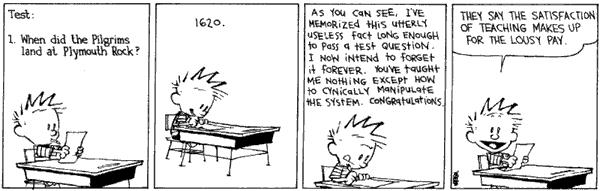
Recently Marion Brady, a teacher, administrator, and curriculum designer wrote an article for the Washington Post When an Adult Took Standardized Tests Forced on Kids. In it she shares information she received from a friend who took the 10th grade test (this is the one that determines graduation, college potential, and of course teacher and administrator pay, and school funding).
The math section had 60 questions. I knew the answers to none of them, but managed to guess ten out of the 60 correctly. On the reading test, I got 62% . In our system, that’s a “D”... “It seems to me something is seriously wrong. I have a bachelor of science degree, two masters degrees, and 15 credit hours toward a doctorate."...“It makes no sense to me that a test with the potential for shaping a student’s entire future has so little apparent relevance to adult, real-world functioning. Who decided the kind of questions and their level of difficulty? Using what criteria? To whom did they have to defend their decisions? As subject-matter specialists, how qualified were they to make general judgments about the needs of this state’s children in a future they can’t possibly predict? Who set the pass-fail “cut score”? How?”“I can’t escape the conclusion that decisions about the [state test] in particular and standardized tests in general are being made by individuals who lack perspective and aren’t really accountable.”In the article Marion Brady also discusses the recent New York Times story Principles Protest Increased Use of Test scores to Evaluate Educators by Michael Winerip.
"President Obama and his signature education program, Race to the Top, along with John B. King Jr., the New York State commissioner of education, deserve credit for spurring what is believed to be the first principals’ revolt in history.As of last night, 658 principals around the state had signed a letter — 488 of them from Long Island, where the insurrection began — protesting the use of students’ test scores to evaluate teachers’ and principals’ performance.Their complaints are many: the evaluation system was put together in slapdash fashion, with no pilot program; there are test scores to evaluate only fourth-through-eighth-grade English and math teachers; and New York tests are so unreliable that they had to be rescaled radically last year, with proficiency rates in math and English dropping 25 percentage points overnight.Mr. Kaplan, who runs one of the highest-achieving schools in the state, has been evaluating teachers since the education commissioner was a teenager. No matter. He is required by Nassau County officials to attend 10 training sessions, as is Carol Burris, the principal of South Side High School here, who was named the 2010 Educator of the Year by the School Administrators Association of New York State.“It’s education by humiliation,” Mr. Kaplan said. “I’ve never seen teachers and principals so degraded.”
Saturday, November 5, 2011
Thursday, November 3, 2011
Direct Action in the System of Education
First a video from NYC - Occupy the Department of Education
Maryland State Board of Education - Search for the new State Superintendent of Schools
Superintendent's dramatically shape the way education happens in schools. They can support or suppress the Arts, focus on testing to the exclusion of other programs, support or end extended day programs, and so much more. Maryland will soon hire a new State Superintendent, but first they're giving everyone a chance to voice what qualities they think the Superintendent should have. People interested in directly participating in this can go online and complete the survey by November 18 2011, or attend a series of open forums held at 2:30 pm and again at 7pm at each of the following locations.
11/3 - Seneca Valley High School (Montgomery County) 19401 Crystal Rock Drive, Germantown, MD 20874
11/7 - Huntingtown High School (Calvert County) 4125 N Solomons Island Rd, Huntingtown, MD 20639
11/7 - Mountain Ridge High School (Allegany County) 100 Dr. Nancy S. Grasmick Lane, Frostburg, MD 21532
11/9 - Edgewood High School (Harford County) 215 Willoughby Beach Rd, Edgewood, MD 21040
11/10 - Baltimore Polytechnic Institute (Baltimore City) 1400 West Cold Spring Lane, Baltimore, MD 21209
Maryland State Board of Education - Search for the new State Superintendent of Schools
Superintendent's dramatically shape the way education happens in schools. They can support or suppress the Arts, focus on testing to the exclusion of other programs, support or end extended day programs, and so much more. Maryland will soon hire a new State Superintendent, but first they're giving everyone a chance to voice what qualities they think the Superintendent should have. People interested in directly participating in this can go online and complete the survey by November 18 2011, or attend a series of open forums held at 2:30 pm and again at 7pm at each of the following locations.
11/3 - Seneca Valley High School (Montgomery County) 19401 Crystal Rock Drive, Germantown, MD 20874
11/7 - Huntingtown High School (Calvert County) 4125 N Solomons Island Rd, Huntingtown, MD 20639
11/7 - Mountain Ridge High School (Allegany County) 100 Dr. Nancy S. Grasmick Lane, Frostburg, MD 21532
11/9 - Edgewood High School (Harford County) 215 Willoughby Beach Rd, Edgewood, MD 21040
11/10 - Baltimore Polytechnic Institute (Baltimore City) 1400 West Cold Spring Lane, Baltimore, MD 21209
Sunday, September 25, 2011
Multiple Intelligences
In 1983 Dr. Howard Gardener developed the idea of Multiple Intelligences. The idea is there are a varieties of areas that people can be smart/skilled in and that our method of IQ testing and education does not address all these different areas. Dr. Gardner came up with eight different types of intelligence, of which seven are discussed and used by psychologists and educators.
These multiple intelligences are:
 Linguistic - Linguistic Intelligence means being smart/skilled with reading, writing, and speaking. Authors, public speakers, news reports, and comedians all need a high Linguistic Intelligence.
Logical/Mathematical - This type of intelligence means being number smart. Scientists, mathematicians, and chess masters all have high Logical/Mathematical Intelligences.
Musical - Musical Intelligence is, perhaps obviously, being smart/skilled in music. This relates to singing, composing music, and playing an instrument.
Intra-Personal - Intra-Personal Intelligence means being smart about yourself. Poets who focus on emotions, many psychologists, actors, and people like Siddhartha and Thoreau all have high Intra-Personal Intelligence.
Inter-Personal - This type of intelligence means being smart about other people. Psychologists, motivational speakers, and people like Machiavelli all have high Inter-Personal Intelligence.
Bodily/Kinesthetic - Bodily/Kinesthetic Intelligence refers to being smart about bodily movement. Actors, gymnasts, dances, and other athletes, along with soldiers and fire fighters all have high Bodily/Kinesthetic Intelligence.
Spatial - This type of intelligence means being picture and space smart. Artists, pilots, and race car drivers all need a high Spatial Intelligence.
Everyone is skilled in one of these areas of intelligence and many people will be smart in multiple areas. People like actors, poets, psychologists, and Air Force pilots need to be skilled in two or three intelligences to succeed in their professions.
However, schools often focus on the Linguistic and Logical/Mathematical Intelligences, sometimes to the exclusion to the other types. This has become more frequent with the advent of high states testing and NCLB. If children do receive education in the other types of intelligences it is often through extra-curricular activities like art, music, and gym, and these extra-curriculars are the first to go when there are problems with budgets or schools need to pull their test scores up. Intra and Inter-Personal Intelligences often aren't addressed in schools and are rarely, if ever, actively taught to children.
Ideally schools would have the funding and time to address every type of intelligence and work the different types into the same lessons so that all children have access to areas they succeed in, and learn material in a method that increases their chances of true understanding. When learning anything classes can read about the lesson (linguistic), learn equations or logical expressions for it (logical/mathematical), observe charts (spatial), listen to or write songs about the material (musical), how what the class is learning affects people (inter-personal), and apply the learned material to the body/themselves (bodily/kinesthetic and intra-personal). When all the types of intelligences are worked into the lesson every child in the class has a higher chance of success.
These multiple intelligences are:
 Linguistic - Linguistic Intelligence means being smart/skilled with reading, writing, and speaking. Authors, public speakers, news reports, and comedians all need a high Linguistic Intelligence.
Logical/Mathematical - This type of intelligence means being number smart. Scientists, mathematicians, and chess masters all have high Logical/Mathematical Intelligences.
Musical - Musical Intelligence is, perhaps obviously, being smart/skilled in music. This relates to singing, composing music, and playing an instrument.
Intra-Personal - Intra-Personal Intelligence means being smart about yourself. Poets who focus on emotions, many psychologists, actors, and people like Siddhartha and Thoreau all have high Intra-Personal Intelligence.
Inter-Personal - This type of intelligence means being smart about other people. Psychologists, motivational speakers, and people like Machiavelli all have high Inter-Personal Intelligence.
Bodily/Kinesthetic - Bodily/Kinesthetic Intelligence refers to being smart about bodily movement. Actors, gymnasts, dances, and other athletes, along with soldiers and fire fighters all have high Bodily/Kinesthetic Intelligence.
Spatial - This type of intelligence means being picture and space smart. Artists, pilots, and race car drivers all need a high Spatial Intelligence.
Everyone is skilled in one of these areas of intelligence and many people will be smart in multiple areas. People like actors, poets, psychologists, and Air Force pilots need to be skilled in two or three intelligences to succeed in their professions.
However, schools often focus on the Linguistic and Logical/Mathematical Intelligences, sometimes to the exclusion to the other types. This has become more frequent with the advent of high states testing and NCLB. If children do receive education in the other types of intelligences it is often through extra-curricular activities like art, music, and gym, and these extra-curriculars are the first to go when there are problems with budgets or schools need to pull their test scores up. Intra and Inter-Personal Intelligences often aren't addressed in schools and are rarely, if ever, actively taught to children.
Ideally schools would have the funding and time to address every type of intelligence and work the different types into the same lessons so that all children have access to areas they succeed in, and learn material in a method that increases their chances of true understanding. When learning anything classes can read about the lesson (linguistic), learn equations or logical expressions for it (logical/mathematical), observe charts (spatial), listen to or write songs about the material (musical), how what the class is learning affects people (inter-personal), and apply the learned material to the body/themselves (bodily/kinesthetic and intra-personal). When all the types of intelligences are worked into the lesson every child in the class has a higher chance of success.
Subscribe to:
Posts (Atom)