Nothing could make me happier than John Stewart talking about teachers and education. His mother is a teacher, he knows a variety of teachers, and whenever Stewart talks about education he makes sure to address what teachers say, instead of only focusing on political officials or lobbying groups.
Yesterday he had Arne Duncan, the current Secretary of Education, and again, he made sure to stand up for teachers and what they say. You can see the video of the interview here on Hulu.
Showing posts with label NCLB. Show all posts
Showing posts with label NCLB. Show all posts
Friday, February 17, 2012

Saturday, November 5, 2011
Thursday, October 20, 2011
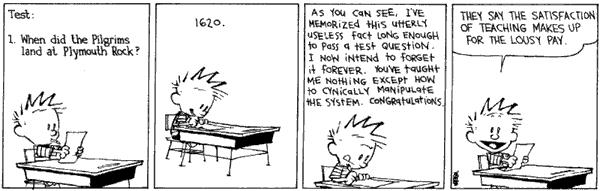
No Child Left Behind Comic

"But if everyone doesn't take the exact same test how can Assessment be fair?" The supporters of NCLB cry. Completely ignoring the differences in in mental abilities (schools can only not test/provide accommodations for 10% of students, despite the fact that ~25% of their students will have some type of special need.) Fluency in English (after 2 years in public schools children have to take NCLB tests in English, no matter what their actual fluency level is) familial support, background education (have they transferred schools a lot? Remember some child transfer almost every year and so might miss sections because schools are on different schedules) school resources (something tells me Montgomery Country, richest county in the country, schools have more to spend on computers, text books, lab equipment, field trips and teachers then Baltimore City, majority of schools have 90-100% of students living below the poverty line.)
But hey, the government said this was fair and then Secretary of Educations Margaret Spellings lack of experience in schools and nonexistent Education Degree totally made her a good judge.
Sunday, September 25, 2011
Multiple Intelligences
In 1983 Dr. Howard Gardener developed the idea of Multiple Intelligences. The idea is there are a varieties of areas that people can be smart/skilled in and that our method of IQ testing and education does not address all these different areas. Dr. Gardner came up with eight different types of intelligence, of which seven are discussed and used by psychologists and educators.
These multiple intelligences are:
 Linguistic - Linguistic Intelligence means being smart/skilled with reading, writing, and speaking. Authors, public speakers, news reports, and comedians all need a high Linguistic Intelligence.
Logical/Mathematical - This type of intelligence means being number smart. Scientists, mathematicians, and chess masters all have high Logical/Mathematical Intelligences.
Musical - Musical Intelligence is, perhaps obviously, being smart/skilled in music. This relates to singing, composing music, and playing an instrument.
Intra-Personal - Intra-Personal Intelligence means being smart about yourself. Poets who focus on emotions, many psychologists, actors, and people like Siddhartha and Thoreau all have high Intra-Personal Intelligence.
Inter-Personal - This type of intelligence means being smart about other people. Psychologists, motivational speakers, and people like Machiavelli all have high Inter-Personal Intelligence.
Bodily/Kinesthetic - Bodily/Kinesthetic Intelligence refers to being smart about bodily movement. Actors, gymnasts, dances, and other athletes, along with soldiers and fire fighters all have high Bodily/Kinesthetic Intelligence.
Spatial - This type of intelligence means being picture and space smart. Artists, pilots, and race car drivers all need a high Spatial Intelligence.
Everyone is skilled in one of these areas of intelligence and many people will be smart in multiple areas. People like actors, poets, psychologists, and Air Force pilots need to be skilled in two or three intelligences to succeed in their professions.
However, schools often focus on the Linguistic and Logical/Mathematical Intelligences, sometimes to the exclusion to the other types. This has become more frequent with the advent of high states testing and NCLB. If children do receive education in the other types of intelligences it is often through extra-curricular activities like art, music, and gym, and these extra-curriculars are the first to go when there are problems with budgets or schools need to pull their test scores up. Intra and Inter-Personal Intelligences often aren't addressed in schools and are rarely, if ever, actively taught to children.
Ideally schools would have the funding and time to address every type of intelligence and work the different types into the same lessons so that all children have access to areas they succeed in, and learn material in a method that increases their chances of true understanding. When learning anything classes can read about the lesson (linguistic), learn equations or logical expressions for it (logical/mathematical), observe charts (spatial), listen to or write songs about the material (musical), how what the class is learning affects people (inter-personal), and apply the learned material to the body/themselves (bodily/kinesthetic and intra-personal). When all the types of intelligences are worked into the lesson every child in the class has a higher chance of success.
These multiple intelligences are:
 Linguistic - Linguistic Intelligence means being smart/skilled with reading, writing, and speaking. Authors, public speakers, news reports, and comedians all need a high Linguistic Intelligence.
Logical/Mathematical - This type of intelligence means being number smart. Scientists, mathematicians, and chess masters all have high Logical/Mathematical Intelligences.
Musical - Musical Intelligence is, perhaps obviously, being smart/skilled in music. This relates to singing, composing music, and playing an instrument.
Intra-Personal - Intra-Personal Intelligence means being smart about yourself. Poets who focus on emotions, many psychologists, actors, and people like Siddhartha and Thoreau all have high Intra-Personal Intelligence.
Inter-Personal - This type of intelligence means being smart about other people. Psychologists, motivational speakers, and people like Machiavelli all have high Inter-Personal Intelligence.
Bodily/Kinesthetic - Bodily/Kinesthetic Intelligence refers to being smart about bodily movement. Actors, gymnasts, dances, and other athletes, along with soldiers and fire fighters all have high Bodily/Kinesthetic Intelligence.
Spatial - This type of intelligence means being picture and space smart. Artists, pilots, and race car drivers all need a high Spatial Intelligence.
Everyone is skilled in one of these areas of intelligence and many people will be smart in multiple areas. People like actors, poets, psychologists, and Air Force pilots need to be skilled in two or three intelligences to succeed in their professions.
However, schools often focus on the Linguistic and Logical/Mathematical Intelligences, sometimes to the exclusion to the other types. This has become more frequent with the advent of high states testing and NCLB. If children do receive education in the other types of intelligences it is often through extra-curricular activities like art, music, and gym, and these extra-curriculars are the first to go when there are problems with budgets or schools need to pull their test scores up. Intra and Inter-Personal Intelligences often aren't addressed in schools and are rarely, if ever, actively taught to children.
Ideally schools would have the funding and time to address every type of intelligence and work the different types into the same lessons so that all children have access to areas they succeed in, and learn material in a method that increases their chances of true understanding. When learning anything classes can read about the lesson (linguistic), learn equations or logical expressions for it (logical/mathematical), observe charts (spatial), listen to or write songs about the material (musical), how what the class is learning affects people (inter-personal), and apply the learned material to the body/themselves (bodily/kinesthetic and intra-personal). When all the types of intelligences are worked into the lesson every child in the class has a higher chance of success.
Sunday, August 7, 2011
Atlanta School Cheating Scandal
I'm sure most U.S. residents with an interest in education have heard about the cheating scandal in the Atlanta school district. I've been meaning to write about it for several weeks, but I've been unable to form coherent thoughts that address what happened in Atlanta. Part of that is how the administrators and press discuss the issue verses the way I (and everyone I know who works in education) see the matter.
The facts are these:
In the beginning of July Georgia Governor Nathan Deal released a report that found that erasure cheating on the 2009 state tests occurred in 44 out of 56 elementary and middle schools. Erasure cheating is when teachers correct wrong answers on a test after students have finished, by erasing wrong answers and filling in the correct ones. The cheating was discovered when test graders noticed suspicious patterns in erasures what were not found in other districts. 178 teachers, principles, and administrators are charged with actively cheating, encouraging it, or ignoring the signs of cheating. An Interim Superintendent, Erroll B. Davis Jr, has been appointed.
Davis, and most of the media*, suggest that the cheating was caused by a lack of ethics in individual teachers coupled with the pressure exerted by then Superintendent Dr. Beverly Hall to have high test scores or face termination. From reports it seems that Davis thinks ethics training and "a more open, transparent and empowering culture," will fix the problem.
When I think about the issue and discuss it with my friends in education we all reach the conclusion that teachers' salaries and retention were based on test scores. When more then 3/4ths of the schools are effected its a systemic problem, and unlikely to be created by one bad superintendent and some unethical teachers. In fact, when taken in context, with the economy being what it is, if test scores are tied to a teacher keeping their job cheating, instead of being the easy option, might seem like the only option.
After all it isn't only in Atlanta schools where cheating on high stakes test occurs, Washington D.C. and Pennsylvania, are under investigation as well. And erasures aren't that most common form of cheating. Teachers are much more likely to help students while the test is going on by correcting their answers in class or allowing them to have calculators when the test specifies otherwise.
The system (with No Child Left Behind) has set impossible goals, like the requirement that 100% of students are "proficient" by 2014. Teacher and principle salaries, bonuses, and retention are often determined largely on Adequate Yearly Progress in state test scores. Furthermore school funding is also tied into AYP. Campbell's Law states that "the more any quantitative social indicator is used for social decision-making, the more subject it will be to corruption pressures and the more apt it will be to distort and corrupt the social processes it was intended to monitor."
I've heard teachers in this country likened to delivery people. The standards, curriculum, and assessment methods are determined by the state and federal government. Many teachers have little time to educate students in areas of interest or provide special lessons or help to students who need them. Strict schedules and teaching to the test are what education has become in the United States. The test themselves rarely go beyond assessing rote memorization and a students ability to quickly fill in bubbles. There's no deeper meaning or higher level learning, and since it's not on the test it isn't being taught in classrooms either.
The countries with the best elementary and secondary education in the world don't oppperate this way. Scandinavian countries are some of the highest performers on global education assessments. Currently Finland is the highest.
We need to go back to trusting teachers to know who to teach without the government beathing down their backs. We need to stop seeing students and education as products. We need to stop applying capitalistic and corporate principles to schools. If we can do this, and take a lessons from Finnish schools, we might (30 years down the road) have a populace with knowledge, creative thinking skills, and personal responsibility. Think about how much better the U.S. would be like that.
*Not all the media does this. The Huffington Post and The Week address the systemic issues.
The facts are these:
In the beginning of July Georgia Governor Nathan Deal released a report that found that erasure cheating on the 2009 state tests occurred in 44 out of 56 elementary and middle schools. Erasure cheating is when teachers correct wrong answers on a test after students have finished, by erasing wrong answers and filling in the correct ones. The cheating was discovered when test graders noticed suspicious patterns in erasures what were not found in other districts. 178 teachers, principles, and administrators are charged with actively cheating, encouraging it, or ignoring the signs of cheating. An Interim Superintendent, Erroll B. Davis Jr, has been appointed.
Davis, and most of the media*, suggest that the cheating was caused by a lack of ethics in individual teachers coupled with the pressure exerted by then Superintendent Dr. Beverly Hall to have high test scores or face termination. From reports it seems that Davis thinks ethics training and "a more open, transparent and empowering culture," will fix the problem.
When I think about the issue and discuss it with my friends in education we all reach the conclusion that teachers' salaries and retention were based on test scores. When more then 3/4ths of the schools are effected its a systemic problem, and unlikely to be created by one bad superintendent and some unethical teachers. In fact, when taken in context, with the economy being what it is, if test scores are tied to a teacher keeping their job cheating, instead of being the easy option, might seem like the only option.
After all it isn't only in Atlanta schools where cheating on high stakes test occurs, Washington D.C. and Pennsylvania, are under investigation as well. And erasures aren't that most common form of cheating. Teachers are much more likely to help students while the test is going on by correcting their answers in class or allowing them to have calculators when the test specifies otherwise.
The system (with No Child Left Behind) has set impossible goals, like the requirement that 100% of students are "proficient" by 2014. Teacher and principle salaries, bonuses, and retention are often determined largely on Adequate Yearly Progress in state test scores. Furthermore school funding is also tied into AYP. Campbell's Law states that "the more any quantitative social indicator is used for social decision-making, the more subject it will be to corruption pressures and the more apt it will be to distort and corrupt the social processes it was intended to monitor."
I've heard teachers in this country likened to delivery people. The standards, curriculum, and assessment methods are determined by the state and federal government. Many teachers have little time to educate students in areas of interest or provide special lessons or help to students who need them. Strict schedules and teaching to the test are what education has become in the United States. The test themselves rarely go beyond assessing rote memorization and a students ability to quickly fill in bubbles. There's no deeper meaning or higher level learning, and since it's not on the test it isn't being taught in classrooms either.
The countries with the best elementary and secondary education in the world don't oppperate this way. Scandinavian countries are some of the highest performers on global education assessments. Currently Finland is the highest.
- All three Scandinavian countries have quality public pre-schools that stress social behavior and personal responsibility, as well as pre-numeracy and pre-lieracy skills. This helps students develop intrinsic motivation, which experts agree is generally better then enternal motivation (which is what high stakes testing does in the U.S).
- Students don't begin formal schooling untill they are seven (the age when most children have mastered gross motor skills and can now sit and focus for longer periods of time.) They also have limited grading and don't track students untill they are in 9th grade. After this about half the students attend academic heavy high schools (with the idea of going on to college) while half attend vocational and trade schools. Also, Finland does not negatively judge people who attend vocational schools.
- Universities and polytechnics run by the government provide free higher education for any student who completes high school and/or passes the traditional matriculation exam.
- Finlands curriculum, as defined by the state, totals 10 pages. Future teachers attend a rigorous and exclusive program and at the end are trusted to know how to educate their students and to pick the appropriate material for age and grade level.
- All schools recieve the same amount of funding. In the U.S. (local and state) funding is determined by property taxes of an area and voter turnout. Areas with more expensive property and higher voter turnout have more money to spend on education. The differences can be several thousand dollars per child.
We need to go back to trusting teachers to know who to teach without the government beathing down their backs. We need to stop seeing students and education as products. We need to stop applying capitalistic and corporate principles to schools. If we can do this, and take a lessons from Finnish schools, we might (30 years down the road) have a populace with knowledge, creative thinking skills, and personal responsibility. Think about how much better the U.S. would be like that.
*Not all the media does this. The Huffington Post and The Week address the systemic issues.
Tuesday, April 5, 2011
Standardized Testing
Generally speaking I'm against standardized tests. It's not so much the idea of state wide assessments so much as the way they're carried out.
Here's a collection of links that help explain the different types of tests and why I'm opposed to them.
Mother Jones - Education: Standardized Tests, Explained
USA Today - Five Years After NCLB took effect, problems remain
New York Times - Schools Cut Back Subjects to Push Reading and Math
Fair Tests - What's Wrong with Standardized Tests?
High Stakes Testing are Standardized Tests that are used for grade promotion, scholarships, determining teachers’ salaries, and funding. NCLB makes the States Standardized Tests tied to the schools' Title I funds and whether the schools might be taken over or sold to private companies. Individual states tie their testing to other benefits and reprisals. Massachusetts requires all students to pass the sophomore level state test to graduate and scholarships to state colleges and universities are partially based on a student's score. Meanwhile, Florida bases teacher's salaries on the testing abilities of students.
On some level a lot of the basis of High Stakes Testing makes sense, as does the consequences. Most problems arise from implementation. Firstly, the tests are often partially biased, both culturally and in an individual day to day manner. Students from the suburbs test better because of the wording. When I did an assessment of a test for second graders one section had picture analogies. These were meant to test students reasoning skills, and ideally they were using everyday objects. However, if you like in a city and don't have a yard you're not going to get the relationship between a rake and trowel or sprinkler and watering can. Or if you do it takes longer to come up with the comparison because these are not objects you'll be personally acquainted with. These biases exist in all tests and are the reason that students from the mid-west score better on the ACT than they do on the SATs, while the reverse is true for students from the East Coast.
Meanwhile, simple things like amount of sleep, whether a person ate breakfast, has a head ache, or numerous other small differences effect how a student scores. This also ties into larger biases when students live in poorer areas and 80-90% of students are on free or reduced meals. Something that might affect several of students from one area, and make them perform more poorly on the tests, is part of the daily lives of the majority of students from other schools. Add the fact that many of these Title I schools are in urban or extremely rural areas and suffer from the biases of the test construction and it becomes apparent that some schools and districts go into High Stakes Testing already behind the curve, and these schools are the ones reliant on government funds to meet the varied needs of their students.
Often these schools are forced to devote a good deal of their time preparing students for the Tests, so subjects like history, science, and foreign languages are over looked. Students also learn how to answer multiple choice questions or word short answers to get more points, but they have no meaningful understanding of the material they're learning and often have difficulty applying it to other scenarios. There are scenes from Season 4 of The Wire that are almost identical to what some teachers and students experience, and it's heart breaking.
Another mark against High Stakes Standardized Testing is that they don't properly account for students with special needs. Under NCLB schools may exempt a certain percentage of their students from the tests for reasons are special needs. However, this percentage is far less than the 20% of students with ADHD and the 10-15% with learning disabilities that require extra time or other accommodations to test at their actual achievement level. Also students who speak English as a second language must take the State Tests after being in US schools for two years; however most of these students are not proficient enough to score well in this time frame. One of my friends works as a bilingual school in New York City, and from kindergarten to 5th grade they transition the students from speaking primarily Spanish to having full English comprehension, and this time frame is rather necessary when students come from homes that don't speak English.
And all of these reasons are why I find the tests themselves biased and therefore damaging to students and American schools. These articles and what I've written barely touch on the consequences of these tests.
Here's a collection of links that help explain the different types of tests and why I'm opposed to them.
Mother Jones - Education: Standardized Tests, Explained
USA Today - Five Years After NCLB took effect, problems remain
New York Times - Schools Cut Back Subjects to Push Reading and Math
Fair Tests - What's Wrong with Standardized Tests?
High Stakes Testing are Standardized Tests that are used for grade promotion, scholarships, determining teachers’ salaries, and funding. NCLB makes the States Standardized Tests tied to the schools' Title I funds and whether the schools might be taken over or sold to private companies. Individual states tie their testing to other benefits and reprisals. Massachusetts requires all students to pass the sophomore level state test to graduate and scholarships to state colleges and universities are partially based on a student's score. Meanwhile, Florida bases teacher's salaries on the testing abilities of students.
On some level a lot of the basis of High Stakes Testing makes sense, as does the consequences. Most problems arise from implementation. Firstly, the tests are often partially biased, both culturally and in an individual day to day manner. Students from the suburbs test better because of the wording. When I did an assessment of a test for second graders one section had picture analogies. These were meant to test students reasoning skills, and ideally they were using everyday objects. However, if you like in a city and don't have a yard you're not going to get the relationship between a rake and trowel or sprinkler and watering can. Or if you do it takes longer to come up with the comparison because these are not objects you'll be personally acquainted with. These biases exist in all tests and are the reason that students from the mid-west score better on the ACT than they do on the SATs, while the reverse is true for students from the East Coast.
Meanwhile, simple things like amount of sleep, whether a person ate breakfast, has a head ache, or numerous other small differences effect how a student scores. This also ties into larger biases when students live in poorer areas and 80-90% of students are on free or reduced meals. Something that might affect several of students from one area, and make them perform more poorly on the tests, is part of the daily lives of the majority of students from other schools. Add the fact that many of these Title I schools are in urban or extremely rural areas and suffer from the biases of the test construction and it becomes apparent that some schools and districts go into High Stakes Testing already behind the curve, and these schools are the ones reliant on government funds to meet the varied needs of their students.
Often these schools are forced to devote a good deal of their time preparing students for the Tests, so subjects like history, science, and foreign languages are over looked. Students also learn how to answer multiple choice questions or word short answers to get more points, but they have no meaningful understanding of the material they're learning and often have difficulty applying it to other scenarios. There are scenes from Season 4 of The Wire that are almost identical to what some teachers and students experience, and it's heart breaking.
Another mark against High Stakes Standardized Testing is that they don't properly account for students with special needs. Under NCLB schools may exempt a certain percentage of their students from the tests for reasons are special needs. However, this percentage is far less than the 20% of students with ADHD and the 10-15% with learning disabilities that require extra time or other accommodations to test at their actual achievement level. Also students who speak English as a second language must take the State Tests after being in US schools for two years; however most of these students are not proficient enough to score well in this time frame. One of my friends works as a bilingual school in New York City, and from kindergarten to 5th grade they transition the students from speaking primarily Spanish to having full English comprehension, and this time frame is rather necessary when students come from homes that don't speak English.
And all of these reasons are why I find the tests themselves biased and therefore damaging to students and American schools. These articles and what I've written barely touch on the consequences of these tests.
Tuesday, February 22, 2011
The Importance of Head Start and Title I
The US Deficit and Budget have been all over the news for the last several weeks and while I have thoughts on a bunch of the proposed or House passed budget cuts one in particular ties into the purpose of this blog.
Last week Rep. Paul Ryan (R-WI) and his colleagues passed $63 billion in budget cuts for the end of fiscal year 2011, with the understanding being that the cuts would continue into 2012. These cuts are all to non-security programs and don't differentiate between successful and failing programs. The Department of Education is undergoing such cuts, particularly to Title I schools and Head Start. Over all the Department of Education will lose almost $5 billion. Source
Head Start and Title I assist people living in poverty and the schools who educate them.
 Head Start provides a variety of services, but is most known for their pre-schools and before and after school care. Most low-income families require both parents or all responsible adults to work, many times several jobs. Therefore they can't provide care for young children and often don't have the time or energy to educate them on pre-literacy and pre-numeracy skills. (I'll do another post later about the necessity of these skills being learned before kindergarten.) Head Start provides pre-school care for the children of these families. They can't reach everyone and Head Start locations are run differently from each other, but once you get in the program you can stay in it, throughout all levels of school.
Head Start teaches skills necessary to academic achievement, they provide safe and supervised places for children of all ages, they provide homework help and academic enrichment. Head Start even helps with college applications and scholarships. Children enrolled in the program often achieve better in academics and are more likely to graduate from high school. Head Start specifically assists children and families who do not have the resources to pay for or find this help from other places. They combat the cyclical and systematic results of poverty and institutionalized racism. For more information about Head Start and the affects of the budget cuts visit their web site here.
A Title I school is a school where 40% or more of the students live at a proverty level where they qualify for free or reduced lunches. Basically this means approximately half or more of the students live at such levels of poverty that their families cannot afford to feed them. When this is the case the schools receive assistance from the federal government, through Title I, to meet the specific needs of children living in poverty. Title I started in the 1960s under the Elementary and Secondary Education Act. No Child Left Behind (NCLB) states that schools must make adequate yearly progress to continue receiving funds.
How Title I funds are used is up to the discretion of the school. They can be used for curriculum enhancement, counseling, increasing parental involvement, more staff and general program improvement. Generally the funds are used for extra instruction in math and reading as these are some of the most important subjects, and since NCLB the test scores for these subjects affect the Title I funds received by the school. Millions of children are assisted anually through Title I funds. For more basic inforamtion visit here. Or the US Department of Education's site here.
Personally, I spent two years working at a Title I school where numerous children where enrolled in Head Start. At this school over 80% of the children received free and reduced lunches and I helped run an after school program which improved children's literacy. Parents had to enroll they're children in our program, and Head Start children did not attend as they received after school care and academic assistance through the Head Start Porgram. The school was making adaquate yearly progress so they were receiving the maximum Title I allotment. The school was also receiving grant money for being a community school (meaning they provided help for the whole community) and there were several other grants helping the school meet the needs of all the children. My program and position was funded by one such grant.
With these four programs providing extra money to the school they were able to provide 2 meals a day to the students who qualified, health services to the students and their families, run before and after school care with sports, arts, and academic programs. They also were able to hold occasional events to promote community involvement and find out how they could better help the needs of the community.
When I compare the kids I worked with at this school to others from similar backgrounds the differences are staggering. They are more confident and happy, they're less likely to skip school or drop out, they could make goals and figure out how to reach them. They also tested very high in the state standardized testing. Which means most of them are at grade level. These children are having their basic health needs met, receiving academic assistance and getting adult support, and it took more then the Title I funds or Head Start to reach all the children in the school. So the idea of cutting funding to Title I and Head Start, to further limiting the number of children they can help, is horrifying. The effects of the budget cuts will be staggering and so hurtful to low income families and eventually the rest of the country. Because everything is connected in some way, and the more one group falls into poverty, crime and illiteracy, the more everyone else does too.
Because of all of this I've signed the petition to save Head Start and I hope others will too.
Last week Rep. Paul Ryan (R-WI) and his colleagues passed $63 billion in budget cuts for the end of fiscal year 2011, with the understanding being that the cuts would continue into 2012. These cuts are all to non-security programs and don't differentiate between successful and failing programs. The Department of Education is undergoing such cuts, particularly to Title I schools and Head Start. Over all the Department of Education will lose almost $5 billion. Source
Head Start and Title I assist people living in poverty and the schools who educate them.

Head Start teaches skills necessary to academic achievement, they provide safe and supervised places for children of all ages, they provide homework help and academic enrichment. Head Start even helps with college applications and scholarships. Children enrolled in the program often achieve better in academics and are more likely to graduate from high school. Head Start specifically assists children and families who do not have the resources to pay for or find this help from other places. They combat the cyclical and systematic results of poverty and institutionalized racism. For more information about Head Start and the affects of the budget cuts visit their web site here.
A Title I school is a school where 40% or more of the students live at a proverty level where they qualify for free or reduced lunches. Basically this means approximately half or more of the students live at such levels of poverty that their families cannot afford to feed them. When this is the case the schools receive assistance from the federal government, through Title I, to meet the specific needs of children living in poverty. Title I started in the 1960s under the Elementary and Secondary Education Act. No Child Left Behind (NCLB) states that schools must make adequate yearly progress to continue receiving funds.
How Title I funds are used is up to the discretion of the school. They can be used for curriculum enhancement, counseling, increasing parental involvement, more staff and general program improvement. Generally the funds are used for extra instruction in math and reading as these are some of the most important subjects, and since NCLB the test scores for these subjects affect the Title I funds received by the school. Millions of children are assisted anually through Title I funds. For more basic inforamtion visit here. Or the US Department of Education's site here.
Personally, I spent two years working at a Title I school where numerous children where enrolled in Head Start. At this school over 80% of the children received free and reduced lunches and I helped run an after school program which improved children's literacy. Parents had to enroll they're children in our program, and Head Start children did not attend as they received after school care and academic assistance through the Head Start Porgram. The school was making adaquate yearly progress so they were receiving the maximum Title I allotment. The school was also receiving grant money for being a community school (meaning they provided help for the whole community) and there were several other grants helping the school meet the needs of all the children. My program and position was funded by one such grant.
With these four programs providing extra money to the school they were able to provide 2 meals a day to the students who qualified, health services to the students and their families, run before and after school care with sports, arts, and academic programs. They also were able to hold occasional events to promote community involvement and find out how they could better help the needs of the community.
When I compare the kids I worked with at this school to others from similar backgrounds the differences are staggering. They are more confident and happy, they're less likely to skip school or drop out, they could make goals and figure out how to reach them. They also tested very high in the state standardized testing. Which means most of them are at grade level. These children are having their basic health needs met, receiving academic assistance and getting adult support, and it took more then the Title I funds or Head Start to reach all the children in the school. So the idea of cutting funding to Title I and Head Start, to further limiting the number of children they can help, is horrifying. The effects of the budget cuts will be staggering and so hurtful to low income families and eventually the rest of the country. Because everything is connected in some way, and the more one group falls into poverty, crime and illiteracy, the more everyone else does too.
Because of all of this I've signed the petition to save Head Start and I hope others will too.
Subscribe to:
Posts (Atom)